Radiator Flush Frequency and Why Skipping It Causes Overheating
A cooling system does not fail loudly at first. It whispers through a slightly warmer gauge, a faint sweet smell near the hood, or a heater that acts weak on a cold Ohio morning. The right radiator flush frequency keeps those small warnings from turning into steam, towing bills, and a warped cylinder head. Most American drivers do not think about coolant until the temperature needle climbs, which is exactly why this service gets skipped so often.
A radiator flush is not glamorous maintenance. It does not feel as satisfying as new tires or fresh brakes. Still, it protects parts that cost far more than the service itself. Coolant carries heat away from the engine, guards metal from corrosion, and helps prevent deposits from settling where flow matters most. For drivers comparing maintenance habits, repair costs, and long-term car care advice, a trusted automotive maintenance resource can help separate smart prevention from guesswork.
Skip it long enough, and the system starts working against itself. Old coolant turns acidic, passages narrow, heat transfer drops, and the engine begins losing its margin for error. That is when overheating stops being a random event and starts becoming the natural result of neglect.
Why Radiator Flush Frequency Changes From One Vehicle to Another
No single mileage number fits every car on American roads. A Phoenix commuter, a Minnesota pickup owner, and a Florida delivery driver all ask different things from the same cooling system. The service interval depends on coolant type, vehicle age, driving pattern, climate, and how well the system has been treated before now. A schedule printed in the owner’s manual gives you the baseline, but real driving often tells the fuller story.
Coolant type sets the first boundary
Modern vehicles use different coolant formulas, and those formulas age in different ways. Older green coolant often needs shorter replacement windows, while many late-model cars run longer-life coolant designed to last for years under normal use. That difference matters because mixing advice from one car into another can create bad maintenance habits fast.
A 2006 sedan with unknown coolant history does not deserve the same confidence as a 2023 crossover with factory-filled long-life coolant. The newer vehicle may have a longer coolant service interval, but that does not mean the fluid can be ignored forever. Time still matters because additives break down even when mileage stays low.
Many drivers make the mistake of treating color as proof. Orange, pink, blue, yellow, and green coolant labels can confuse even careful owners because color alone does not confirm chemistry. The safer move is to check the owner’s manual, the reservoir cap, or a service record before topping off or flushing anything.
Driving conditions shorten the safe window
City driving is harder on coolant than it looks. The engine heats up, cools down, idles in traffic, and sits through short trips where moisture and contaminants do not always burn off cleanly. That stop-and-go routine is common in places like Los Angeles, Dallas, Chicago, and Atlanta, where traffic turns simple errands into heat cycles.
Towing adds another layer. A pickup pulling a boat in Texas or a small SUV climbing mountain roads in Colorado puts more demand on heat control than the same vehicle cruising flat highways. The radiator, water pump, thermostat, hoses, and fans all work harder to keep the engine steady.
Mileage matters, but hours matter too. A car that idles often can age its cooling system without adding many miles. That is why police vehicles, rideshare cars, delivery vans, and work trucks often need closer attention than a weekend car with the same odometer reading.
What Old Coolant Does Inside the Cooling System
A neglected cooling system does not fail because the coolant “gets dirty” in some simple way. The deeper problem is chemical. Coolant loses the additives that protect metal, control corrosion, and help the fluid move heat cleanly. Once that protection fades, the system can start building the problem from the inside out.
Corrosion starts where you cannot see it
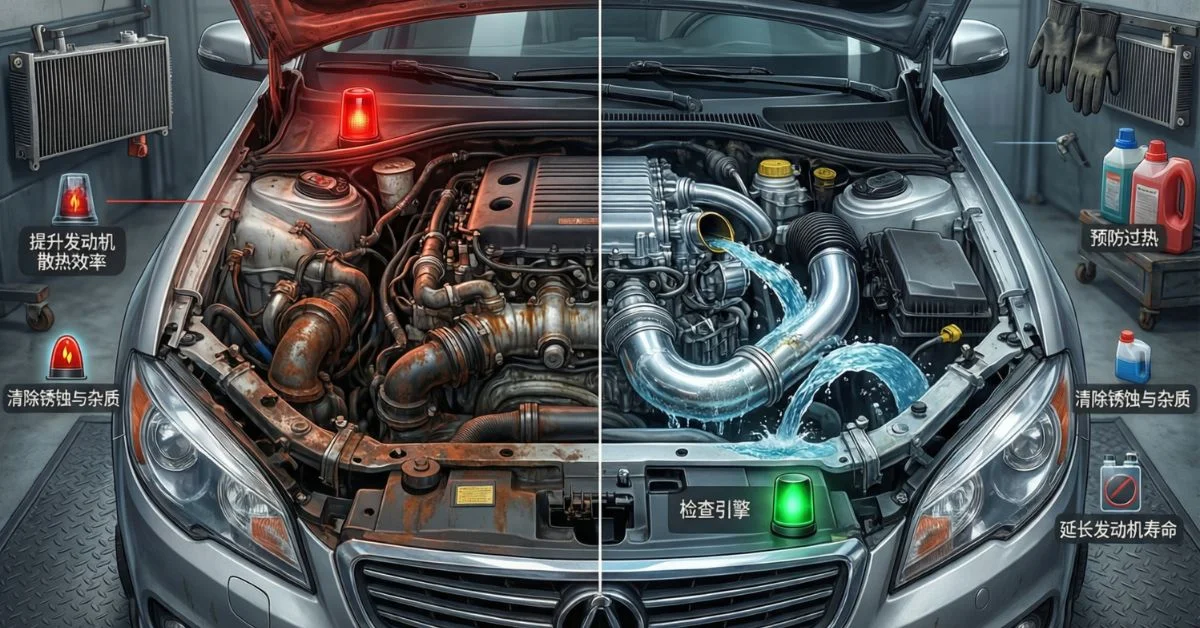
Engines contain different metals, and coolant has to protect them while heat keeps cycling through the system. When the additives wear down, corrosion begins in hidden places: inside the radiator tubes, around the heater core, near the water pump, and along internal passages in the engine block.
That corrosion can create fine debris that moves through the coolant. At first, it may not block anything. Later, it can gather in narrow passages and reduce flow. This is where cooling system maintenance becomes less about neat fluid and more about protecting circulation.
A shop may see this when draining coolant that looks rusty, muddy, or oily. Sometimes the reservoir shows flakes or dark sludge. A driver may notice no warning until the heater weakens or the temperature gauge creeps upward at red lights. By then, the system has already lost some of its breathing room.
Deposits reduce heat transfer before parts break
A radiator works by moving heat from coolant into thin metal passages and then out into the air. Deposits inside those passages act like insulation. The coolant may still move, but it cannot shed heat as well as it should.
This is the part many drivers miss. The system can look full and still perform poorly. A full reservoir does not prove the radiator is clean, the thermostat is opening correctly, or the fan is pulling enough air at idle.
Consider a family minivan in suburban Florida. It may survive highway drives because air flows through the grille at speed. Then it overheats in a school pickup line because low-speed cooling depends more on clean passages and fan performance. That kind of failure feels sudden, but the buildup behind it was slow.
How Skipping Service Turns Heat Into Expensive Damage
Overheating rarely stays contained. Once the temperature climbs beyond the safe range, heat spreads through the engine in ways that punish gaskets, seals, hoses, and metal surfaces. A missed coolant service can become a repair chain, and each link costs more than the one before it.
The thermostat and water pump take extra stress
The thermostat controls coolant flow based on engine temperature. Old coolant can leave deposits around it, making movement less clean over time. A thermostat that sticks closed can send the temperature gauge upward fast, especially during summer traffic.
The water pump faces its own problem. It depends on clean coolant for smooth operation and seal life. Corrosive fluid can wear seals, encourage leaks, and make the pump less dependable. A weak pump may not fail in a dramatic way at first. It may only move coolant poorly enough to cause heat spikes under load.
This is why engine overheating can feel confusing. One day the car runs fine on the interstate. The next day it overheats while climbing a hill with the air conditioning on. Heat exposes weak parts because the system has less reserve left.
A head gasket repair can start with a cheap missed service
A severe overheat can warp metal surfaces or damage the head gasket. Once that happens, coolant and combustion pressure may end up where they do not belong. The signs can include white exhaust smoke, coolant loss with no clear leak, milky oil, bubbling in the reservoir, or rough running after startup.
That repair is not in the same universe as preventive service. A flush and inspection costs far less than removing a cylinder head, checking for warpage, replacing gaskets, and fixing related damage. The painful part is that many of these failures begin with small choices that seemed harmless.
A driver in Nevada may postpone service because the car “still runs cool.” Then one summer weekend, a long uphill grade and 105-degree heat expose every weakness at once. The cooling system did not betray the driver. It ran out of forgiveness.
Radiator Flush Frequency for Smarter Long-Term Ownership
Smart maintenance is not about flushing coolant too often. It is about choosing the right point before old fluid starts damaging the system. That balance protects your car without wasting money on service it does not need yet. The best radiator flush frequency comes from the owner’s manual first, then adjusts for age, climate, use, and warning signs.
Check records before choosing a service interval
Service records tell a better story than memory. If you bought a used car and cannot prove when the coolant was last serviced, treat that gap seriously. Many used vehicles roll through private sales and small lots with clean interiors but unknown cooling system history.
A careful mechanic can test coolant condition, inspect hoses, look for leaks, check pressure, and look inside the reservoir. That inspection matters because flushing a neglected system without checking weak parts can uncover leaks that sludge had been hiding. That sounds annoying, but it is better than finding the leak on the shoulder of I-95.
Internal links help readers move deeper into related care topics, so a maintenance site could connect this guide to posts on coolant leak warning signs and thermostat replacement symptoms. Those topics support the same ownership decision without competing with this one.
Warning signs should override the calendar
A schedule is useful until the vehicle gives you stronger evidence. Rust-colored coolant, floating particles, a sweet smell, repeated top-offs, weak cabin heat, or unexplained temperature movement all deserve attention before the next planned interval. Waiting for the exact mileage number can turn a manageable issue into a roadside failure.
The counterintuitive truth is that overheating is not always caused by low coolant. A system can be full and still overheat because flow, pressure, or heat transfer has been compromised. That is why topping off the reservoir again and again is not a fix. It is a delay.
American drivers who plan to keep a vehicle past 100,000 miles should treat coolant service as part of ownership, not a repair reaction. Check the manual, confirm the correct coolant formula, inspect the system, and schedule the service before summer heat or heavy travel exposes the weak spots.
Conclusion
A healthy cooling system gives an engine room to work. It absorbs heat, moves it away, and protects metal parts while you drive through traffic, weather swings, long commutes, and family road trips. Once coolant breaks down, that margin shrinks. The car may still start, idle, and drive, but the protection behind the scenes has already changed.
The smartest approach is simple: treat radiator flush frequency as a planned maintenance decision, not a panic move after the gauge climbs. Start with the owner’s manual, then adjust for your driving life. Hot climates, towing, heavy idling, older vehicles, and unknown service history all deserve closer attention.
Skipping this service rarely saves money in the long run. It only moves the cost forward and makes the final bill harder to control. Open your maintenance records, check your coolant condition, and book an inspection before the next heat wave or long highway trip forces the issue.
Frequently Asked Questions
How often should most drivers flush a car radiator?
Most drivers should follow the interval listed in the owner’s manual because coolant formulas vary by vehicle. Many cars fall somewhere between several years and a set mileage range. Older vehicles, severe driving, towing, and unknown service history may call for earlier service.
What happens if coolant is never flushed?
Old coolant loses protective additives and can become corrosive. That allows rust, scale, and deposits to form inside the radiator, heater core, water pump, and engine passages. Over time, flow drops, heat transfer weakens, and overheating becomes more likely.
Can old coolant cause overheating even if the reservoir is full?
Yes. A full reservoir only proves the system has fluid. It does not prove the radiator is clean, coolant is flowing well, the thermostat is working, or the fan is moving enough air. Poor heat transfer can overheat an engine even with coolant present.
Is a radiator flush the same as draining coolant?
No. A basic drain removes some old coolant, but fluid often remains inside the engine block, heater core, and hoses. A flush is meant to move more old fluid and loose buildup out of the system before fresh coolant goes in.
What are signs my car needs coolant service soon?
Watch for rusty coolant, sludge in the reservoir, sweet smells, repeated coolant top-offs, weak cabin heat, rising temperature at idle, or unexplained overheating. Any of these signs deserves inspection before a routine interval becomes an emergency repair.
Should I flush my radiator before a long road trip?
It depends on the coolant condition and service history. If the coolant is old, dirty, low, or unknown, inspection before a long trip is smart. Do not flush the system the night before travel without checking hoses, leaks, and pressure first.
Can using the wrong coolant damage the cooling system?
Yes. Some coolant types do not mix well, and the wrong formula can reduce corrosion protection or create deposits. Always match the coolant type listed for your vehicle. When in doubt, ask a qualified shop to identify the correct fluid.
Is radiator flushing worth it on an older car?
Yes, when the system is inspected first. Older cars often benefit from clean coolant, but worn hoses, weak radiators, or hidden leaks may appear during service. A good shop checks the system before flushing so prevention does not turn into surprise damage.